It has been an absolute pleasure to work with the LimeWharf gallery, one of the many projects headed by Thomas Ermacora, to produce a London version of Adhocracy, especially having the honour of being the first show in their space at 45 Vyner Street.
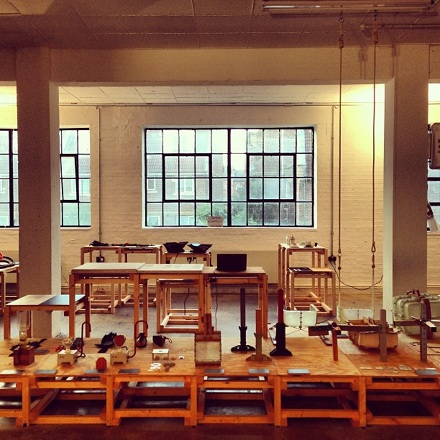
Adhocracy revolves around a network of diverse but interconnected individuals and collectives, many of them forming the backbone of the show—projects like OpenStructures, which also provided the schematic for the exhibition tables. Still, new projects seep into each production, affecting the emphasis of the entire constellation of objects. Here, I wanted to discuss some new projects at greater length.
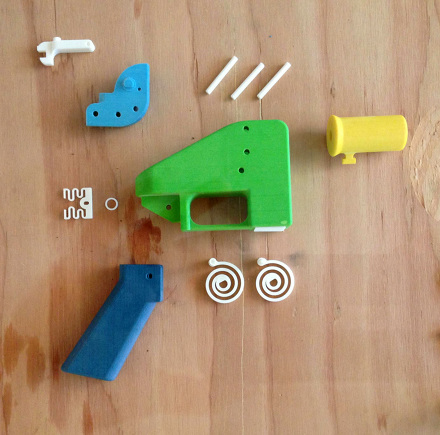
One of the most dynamic aspects of Adhocracy is the way it adapts to the local context in which it is displayed. The 3D-printed gun by Cody Wilson of Defense Distributed is a key example: here in London, gun crime pales in comparison to knife crime, but the weapon itself is still an inflammatory object in the public consciousness. That, combined with the advanced development of 3D-printing technologies in the U.K., made the printing of the gun a somewhat complicated task. We finally came to an agreement with Digits2Widgets to produce the gun out of different materials, including plaster and wax (in other words, it couldn't possibly be fired), and return the gun to be destroyed at the conclusion of the exhibition.
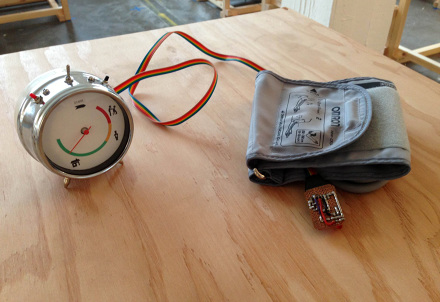
At the other end of the spectrum is Clock Sense by Frugal Digital, a research group connected to the Copenhagen Institute of Interaction Design that bridges the facilities gap between advanced service economies like Scandinavia and developing contexts such as India. The common alarm clock has been adapted into a barometer for readings like blood pressure or temperature, but it also interprets the data and communicates the essential status of the patient—healthy, in need of consultation, or in need of emergency attention—with colours and pictograms. In this way, it enables ASHAs (healthcare workers with minimal training) to provide care even if they do not share a language with their patient (a potential obstacle in a place like India with hundreds of different mother tongues).
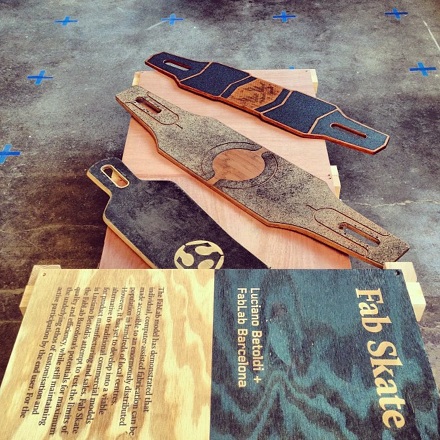
Like many projects in previous iterations of Adhocracy, Fab Skate may not seem especially innovative at first glance: it looks roughly like a normal skateboard, yet it is the outcome of a highly nuanced and iterative design process that proposes a completely different way of making a skateboard deck. By simplifying or parametricising some steps of the process (reducing the number of laminated veneers, replacing laborious hand-cutting with precise laser-cutting), Luciano Betoldi improves other factors (sustainability and customisation) that would normally make the board prohibitively expensive. The final result is a FabLab-based product that could compete with mainstream commercial models, which thus far has been a little-attempted goal in the open-source movement.
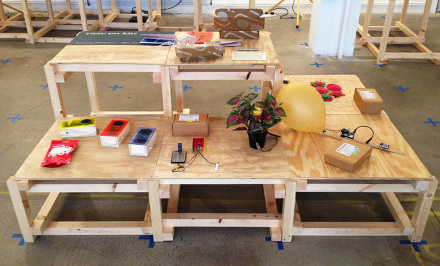
Technology Will Save Us, meanwhile, look at open-source technology as a new kind of language for younger generations, one that transforms them from passive consumers into informed and active creators, hackers, and engineers. Their DIY kits—from circuit board sunglasses with programmable LEDs to a soil moisture sensor that triggers a flashing light when plants need watering—introduce users to the mix of manual and conceptual skills needed to become fully "literate" in basic electronics and problem-solving. I was most impressed that they describe themselves as a business rather than a studio; of all the projects in Adhocracy, this young team, headed by Fabrica alumni, may have the most viable economic model.
The musical projects in Adhocracy tend to be among the most delightful, and the tradition carries on at LimeWharf. We are incredibly fortunate to have four of Felix Thorn's musical machines as part of the show. The others are more spectacular, but this little wooden one is the most charming of all, translating the readings of a proximity sensor into percussive intensity.
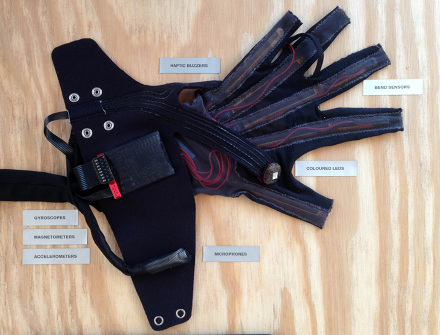
Although they are not displayed in action, these musical gloves for Imogen Heap are another innovative take on the intersection of digital technology and musical composition and execution. Heap and a team of engineers, coders, and artists adapted a set of sensor-equipped gloves to control sound through physical motion. The gloves are part of an entire apparatus with a harness and bolero, capable of interfacing with digital or hybrid systems such as Ableton and Kinect to create a highly nuanced spatial and choreographic performance. See her full explanation and demo at Wired here.
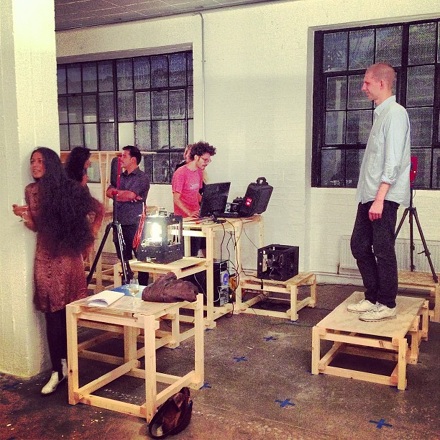
Even with the inclusion of so many wonderful projects, we were also happy to host a special appearance by blablabLAB, who ran a local Be Your Own Souvenir workshop to produce miniature plastic journalists for the press preview.
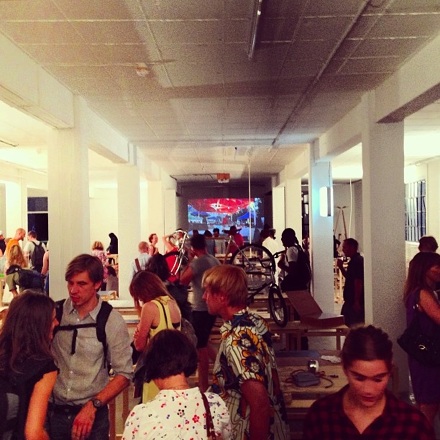
And many thanks to all who came to the opening during First Thursdays on Vyner Street! Beyond the great turnout, we were really impressed to see so many engaged visitors, full of provocative questions about the future of distributed models for creation.