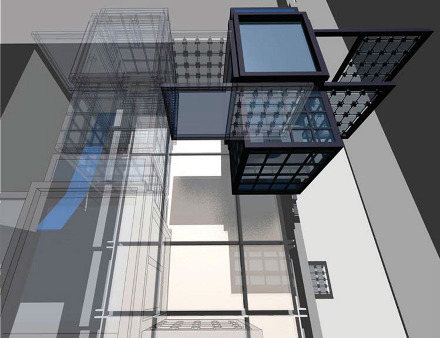
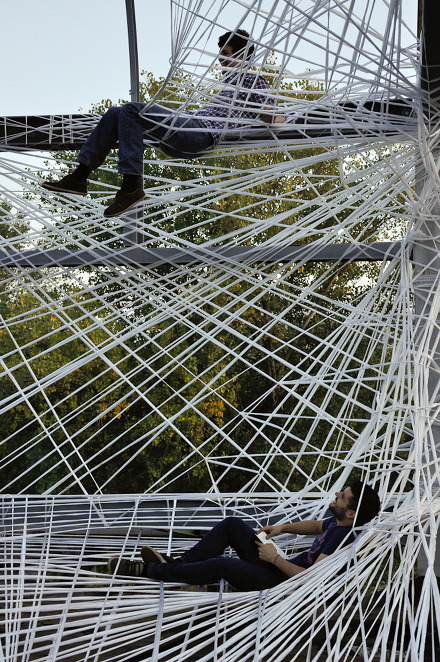
Thanks to DomusWeb for publishing my latest article about
Parasite 2.0's architectural installations in Venice!
As a program assistant in the Architecture & Design department at the
Danish Institute for Study Abroad, I had the opportunity to lead American students in several drawing workshops.
Photo by Celsa Dockstader
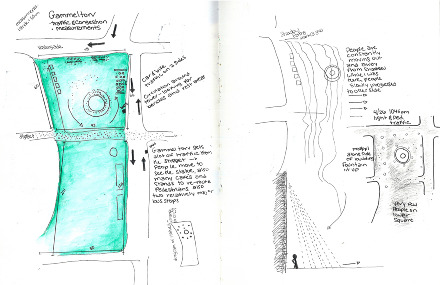
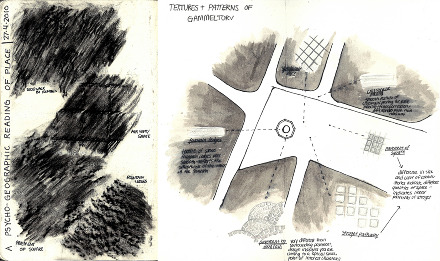
The workshops were designed as mapping exercises in public space, but the focus was shifted to the elements that are more difficult to represent in normal planimetric representations of a territory. Here, the students used overlapping drawings, textual and textural notations, and temporary phenomena to document the experience of Gammeltorv, a square in the inner city of Copenhagen.
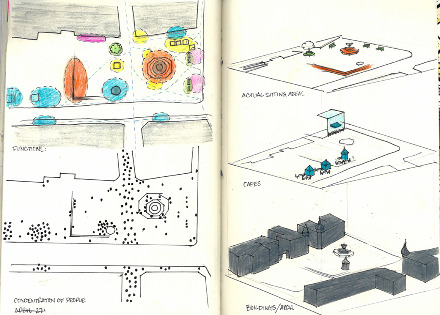
With many thanks to Courtney D. Coyne-Jensen.
Office buildings are high energy consumers due to cooling loads from occupants and mechanical equipment, and current trends for glass curtain wall envelopes merely exacerbate this condition.
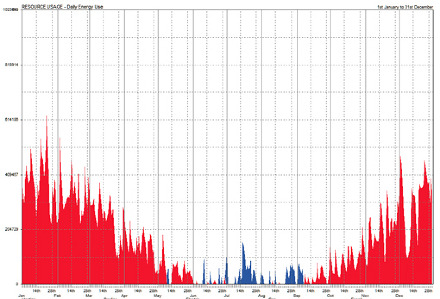
When creating an energy strategy for such a building, there is an inherent negotiation between energy savings from shading for the reduction of heat gain versus savings from the introduction of daylight.
This exploration uses folding and perforation as strategies for creating favourable conditions in a building envelope, with western and southern faces of varying porosity based on seasonal and daily sun angles.
These "shades of distinction" utilise the reflection of sunlight off of neighbouring buildings and paved ground in New York City to contribute daylight and aerial views to an interior space while orienting more opaque surfaces to the direct sunlight from above.
The percentages of surface aperture and opacity are altered to create a balance between heat gain and useful daylight. The design thus operates as a feedback loop between the form as a condition of visual interest and the performance as a measure of thermal gain, optimal visibility, and glare mitigation.
Published in
Building after Katrina: Visions for the Gulf Coast
In the aftermath of Hurricane Katrina, architectural design solutions must account for immediate problems such as above-ground sea levels, shortages of shelter and community spaces, and the lack of water and energy availability; at the same time, they should address long-term issues such as wetland depletion, energy-grid dependency, and inefficient government action.
This project took on the challenge of designing a school in the lowest area of New Orleans, the Broadmoor neighbourhood, at three metres below sea level.
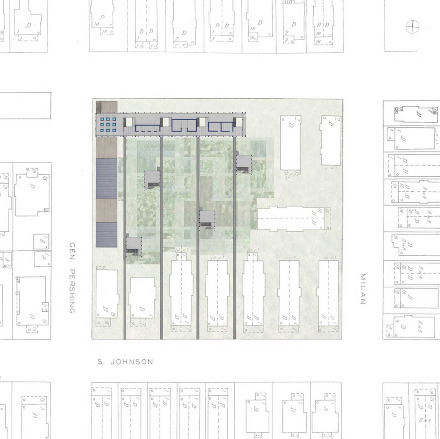
The design scheme, situated among other houses for safety, separates the elements (individual classrooms, shared common rooms on an elevated, screened platform, and space for administration on a boardwalk structure) to enable a patchwork approach to construction.
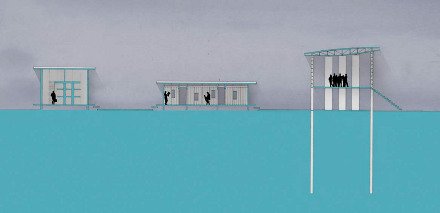
These elements are placed around and within a constructed wetland, which could act as a buffer in instances of slight flooding.
The design prioritises lightweight, cheap, and fast construction techniques, leading to spaces that can operate without air-conditioning (which may not be available after disasters).
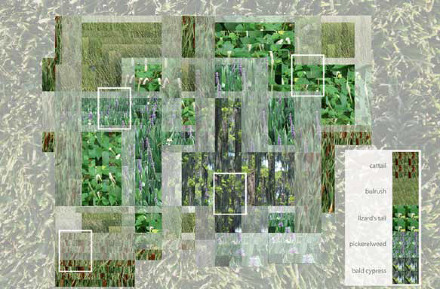
The wetland is also seen as an opportunity to educate New Orleans students; each classroom is located at a subtly different depth of water, giving each structure its own unique biotic microculture.
The live|work pod fits the personal and professional spatial needs of a tattoo artist into a single volume with the dimensions of a standard shipping container (2.5 m x 2.5 m x 6 m), to be placed on an urban rooftop.
The strategy in this design employs sliding panels with three different modules—an open frame, a glass surface, or an opaque surface—that either divide or connect the interior spaces for their optimal use.
The pod is used mainly as a continuous, light-filled space for designing and socialising, with the tattooing equipment condensed into the smallest possible space at one end. When a customer comes, the personal space of the artist is sealed off for sanitary purposes, and the tattooing environment becomes more closed-off and focused.
As the panels move in and out of the pod, design images, rendered on transparencies and affixed to the glass panels, are projected by the angled sun onto the sidewalk beneath the pod, as a dynamic advertisement for the artist.